
What Love Made Possible
On marriage, endurance, and becoming more fully alive

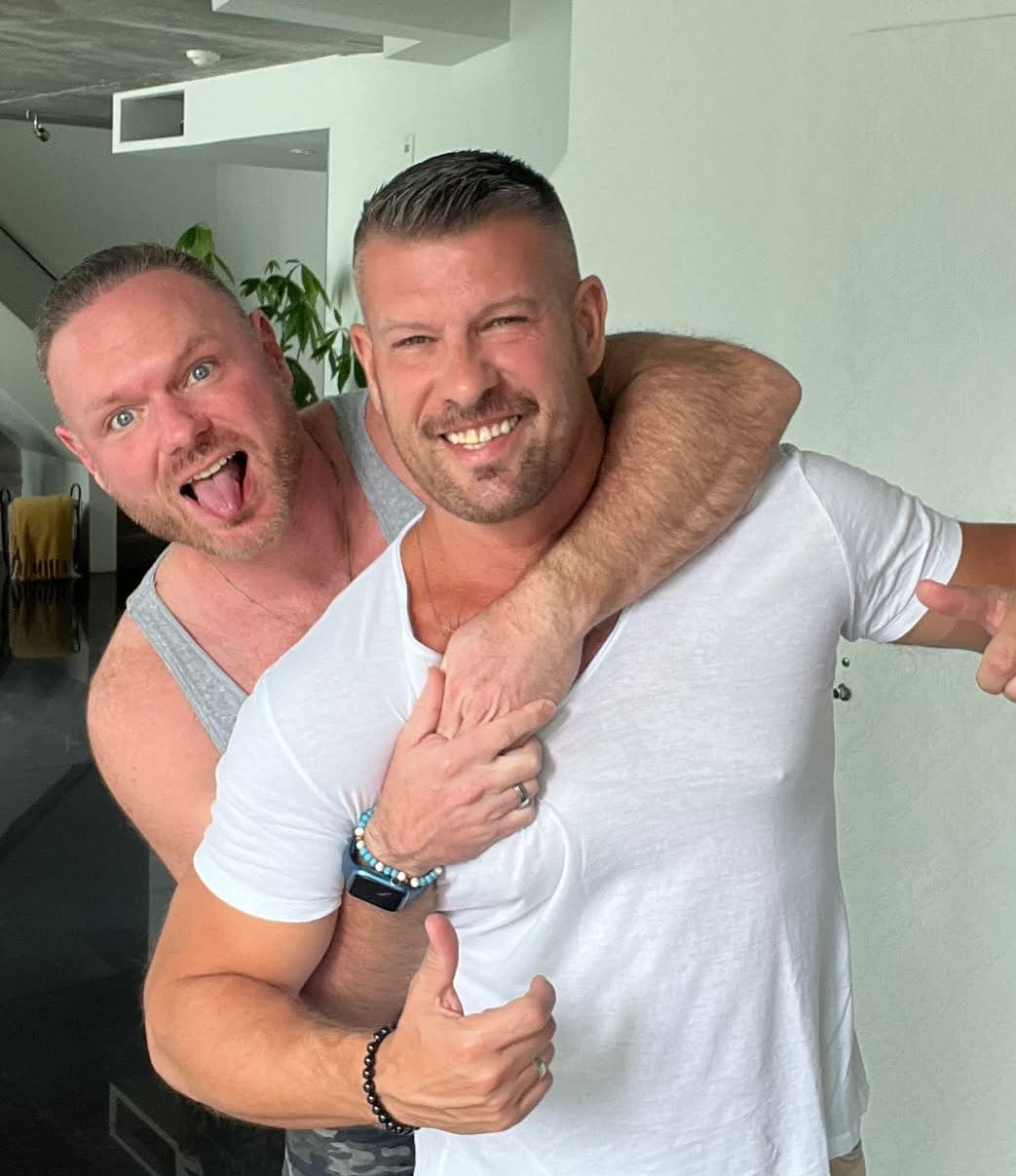
This weekend, ten years ago, Luc and I met by chance.
If you know us now — or if you have seen the photographic evidence — it will not surprise you to learn that our life together has included a fair amount of silliness, chaos, laughter, and the occasional deeply unserious moment. I’m grateful for that. Real love, at least in my experience, has had a lot more goofiness in it than poetry tends to admit.
Still, with a decade of distance, what feels clearest to me now is not only that I fell in love. It is that, from almost the hour we met, we began building a life together.
I have written elsewhere about that night and the strange, swift unfolding that followed. What feels truest to say here is simpler: the life we built gave me something I needed more than I fully understood at the time — stability. Structure. Ground. A place where the scattered parts of me could begin, slowly, to gather.
I have written a good deal about fragmentation, integration, and the long work of becoming someone who can actually inhabit his life. All of that is true. But another truth sits underneath all of it, and I want to name it plainly: the life I have built over the last ten years was not built by insight alone. It was made possible, in no small part, by love.
When I met Luc, I had already stepped out of my former life psychologically, even if I was still living inside its outer forms. I was still a priest. A week before I met him, I called my mother and said, simply and definitively, “I’m done.” I can still feel how clean that sentence was. Not theatrical. Not confused. Not even loud. Just final. Something in me had already stepped beyond the life I was still outwardly living.
That sentence did not instantly rearrange my life. It did not resolve the practical, emotional, spiritual, or geographic realities still around me. But it marked something real. I was no longer trying to return to the life I had been living. I had crossed an interior line.
So when Luc and I met, I was not waiting to become someone else. I was already in the painful, disorienting process of becoming. What I did not yet have was a structure sturdy enough to hold that becoming. I suspect many lives change this way: not when everything is resolved, but in the middle of the unfinished crossing.
My family is part of what the word home means to me, and always will be. But what Luc and I began building was a different kind of home: not home as origin, but home as beginning again. A shared life in which I could become more fully myself with a little more room, and a little less fear.
Some worlds train you early to monitor yourself: to listen for disapproval before it is spoken, to register the shift in the room, to stay a step ahead of judgment. I had lived inside that reflex for so long that safety itself felt strange at first. To begin again inside a life shaped less by scrutiny and more by affection changed the conditions of my life. Most of us, at some point, discover how much of who we have been was shaped by the conditions under which we had to survive.
I do not mean that our marriage was perfect, or that the last ten years can be told as one long hymn to domestic ease. That would not be true. There were times when what held us together was not ease but strength of will. Not romance in its cinematic form, but the quieter disciplines of staying, returning, and continuing — and of trying to hold together a shared life even in moments when we were not entirely sure it would hold. But that too is part of what I mean. The life Luc and I built together gave me stability even when it was imperfect, and that stability became the ground on which the most transformative decade of my life could unfold.
As a priest, I was sometimes asked to give marriage counseling, which now strikes me as at least a little absurd. I do not, in general, recommend seeking out celibate priests for marriage advice. At the time, I knew the theology, the official language, the idealized structure. What I did not know was what marriage looked like from the inside: how much of it is made not of grand declarations but of repetition, repair, patience, shared burdens, timing, endurance, humor, and the decision to keep building a life together even when the feeling of ease has gone temporarily missing.
That, I learned later.
I learned, too, that marriage is one of the clearest mirrors a life can offer. It asks you not only to live with another person’s imperfections, but to encounter your own in forms that become harder to ignore. Disagreements do that. So does proximity. So does love that lasts long enough to move beyond idealization. Partnership has a way of stripping sentimentality from love and replacing it with something both harder and more merciful: the chance to be seen in your limits, to see another person in theirs, and to keep building a life together anyway.
I was no longer improvising alone. There was another person there. Meals. Mornings. Evenings. Laughter. Return. Shared plans. Shared burdens. Shared time. The quiet architecture of a life.
And from within that architecture, things in me began to settle.
Over the last ten years, I have done the most meaningful and productive work of my life. I have done it in a new country, in a life I once could not have imagined for myself. I have helped advance causes in philanthropy and education that I believe in deeply. I have advocated—sometimes loudly, and sometimes very publicly—for people who were hurt in some of the ways I was hurt by the church and other forms of institutional religion. I have written things I might once have been too afraid to write. More than that, I have become more inhabitable to myself. I have become a man, fully alive. I have developed what I have elsewhere called interior authority. I have gone on discovering meaning after meaning.
I have also come to see more clearly how a fragmented life begins to come together: not all at once, and not by insight alone, but through love, risk, truth, endurance, and the slow accumulation of forms that can actually hold a life. None of that came from love alone, of course. It came from work, risk, suffering, grace, and time. But I do not think it would have unfolded as it did without the foundation Luc and I began laying almost from the hour we met.
Some people think love is what arrives after a person becomes whole. As though first one must finish the inward work and only then be ready to receive or sustain a real partnership. There is some truth in that, perhaps. But I think the sequence is often less tidy than that. Sometimes love is not the reward at the end of becoming. Sometimes it is one of the conditions that makes becoming possible at all. Not only romantic love, either. Sometimes it is friendship. Sometimes family. Sometimes the rare steadiness of someone who makes a truer life feel safe enough to begin.
I know now that stability is not a minor thing. It is generative. It frees energy. It lowers noise. It allows what is fragile to strengthen. It gives the nervous system a chance to unclench. It makes room for work, imagination, repair, and joy. It is not the opposite of freedom. Very often, it is what makes freedom sustainable.
And love, when it is real, is not always soft. It is not only longing, intensity, chemistry, or romance suspended above ordinary life. Sometimes it is structure. Sometimes it is repetition. Sometimes it is simply the decision, again and again, not to vanish from the life you have built.
That is part of what I mean when I think about Luc now, ten years on.
I think of the chance meeting, yes. The spark. The strange sense that something had begun. But even more, I think of what followed. The staying. The building. The fact that what began in chance became a form. A life. A marriage. A decade.
I think too of how many pieces of my writing have circled this truth without naming it directly. Underneath so much of it is this quieter truth: love was not a side plot in that story. It was one of the ways the story became livable.
I do not write this because I think the last ten years prove anything tidy about love, or marriage, or the triumphant arc of having made it. I write it because, looking back, I can see clearly that the life Luc and I built together gave me the stability from which so much else became possible.
The past decade has changed me. In many ways, it has been the decade in which I most fully came alive. And whatever else can be said about marriage, or endurance, or the strange and difficult grace of building a shared life with another person, this is true: I would not be who I am now without the steadiness that life gave me.
Some lives are changed by revelation. Others are changed by what gets built, day after day, imperfectly and for real. I used to think love might be the reward at the end of becoming. Now I think it is often one of the conditions that makes becoming possible at all.
And perhaps that is true in more lives than we admit: that what finally helps us become ourselves is not certainty, not self-sufficiency, but the presence of something—or someone—steady enough to help us begin.
It probably helps, too, if they can make you laugh — and if every now and then one of you still does something ridiculous while the other one grins and puts up with it.
So moving. Universal truths in what you said that I can see floating around in pieces in so many lives, my own included, but that you have fitted together in some nice way that I think most everyone can relate to. Thank you. (And I love seeing how you have worked your own life pieces and growth in such an extraordinary way.)
So beautifully written. Congratulations on 10 wonderful years together. Wishing you both continued love, understanding and the comfort of being “one”.